


7 Hardwired vs Plug-In EV Charger Pros and Cons to Know

Last Updated: October 25, 2026
Quick Summary
The hardwired vs plug-in choice comes down to permanence versus flexibility. Hardwired chargers connect directly to a dedicated circuit for higher amperage and fewer failure points, while plug-in chargers use a NEMA 14-50 outlet so you can unplug and take the unit with you.
Hardwired units allow higher amperage and faster charging than plug-in setups limited by a standard receptacle.
Plug-in installs usually need a GFCI breaker at the panel; hardwired installs rely on the charger's internal ground-fault protection.
The circuit must be sized at 125% of the charger's rated current under the continuous-load rule.
Real charging speed is the lowest of circuit capacity, charger output, and the vehicle's onboard charger.
Load management can add charging without a full service upgrade when your panel is near its limit.
Table of Contents
Hardwired vs Plug-In EV Charger: The Core Difference
The hardwired vs plug-in EV charger decision comes down to one question: permanent connection or removable one? A hardwired unit connects directly to a dedicated circuit with no outlet in between.

At Star Bright Electric, we install both types across Northeast Ohio, and neither wins outright. What matters is your panel capacity, your parking setup, and whether you plan to move the charger later.
How Each One Connects to Your Home
A hardwired EV charger is wired straight into a junction box on a dedicated 240-volt circuit. There is no plug, no receptacle, and no exposed connection point.
A plug-in EV charger terminates in a cord that plugs into a NEMA 14-50 outlet, the same style receptacle used for large appliances.
That single mechanical difference drives every trade-off that follows: charging speed, weather exposure, portability, and installation labor.
Pros and Cons of a Hardwired EV Charger
Hardwiring is the more permanent choice, and for many homeowners the better one. It removes a failure point, allows higher amperage, and handles outdoor placement more gracefully, but it stays put.
Where Hardwiring Wins
Higher amperage and faster charging. A hardwired circuit supports more current than a plug-in setup limited by a standard receptacle, so it can charge faster.
Fewer failure points. No plug-and-receptacle connection means one less spot for heat buildup or loose contact.
Better weatherproofing. Hardwired connections suit outdoor installation because there is no exposed plug to protect from rain and snow.
Where Hardwiring Falls Short
No portability. Sell the house or move, and the charger stays with the wall.
More involved installation. Hardwiring usually means conduit, a junction box, and a permit, so the labor side is larger.
Not a DIY swap. Changing or upgrading the unit later requires an electrician again.
Pros and Cons of a Plug-In Level 2 EV Charger
A plug-in Level 2 EV charger trades a little performance for flexibility: a 240-volt circuit, a real speed upgrade over a standard wall outlet, and the ability to unplug and relocate the unit.
Where the Plug-In Setup Wins
Portability and flexibility. Unplug it, box it, and take it to a new home or rental property.
Simpler replacement. If the charger fails, you unplug it and plug in a new one without touching the wiring.
Straightforward install when the outlet already exists. If a NEMA 14-50 receptacle is already in place, the job is quick.
Where the Plug-In Setup Falls Short
Capped charging current. The receptacle and plug impose a ceiling on how much current the circuit can safely deliver, limiting maximum charging rate.
Extra connection points. The plug and receptacle add two spots where heat and wear can develop.
Outdoor exposure concerns. A plug connection outdoors needs proper weatherproofing and a suitable receptacle enclosure.
EV Charger Circuit Requirements You Need to Plan For
Every Level 2 installation starts with a dedicated 240-volt circuit and a correctly sized breaker, shared with nothing else. The charger draws a continuous load for hours, so wiring, breaker, and conduit must be sized for that duty, not a short burst.
The key number is the continuous-load rule. The National Electrical Code treats EV charging as a continuous load, so the circuit must be sized at 125% of the charger's rated current.
Plan for these pieces before anyone opens a wall:
A dedicated 240-volt circuit run from the panel
A breaker sized to 125% of the charger's continuous current
Conductors and conduit rated for that continuous load over the full run length
Ground Fault Protection: Hardwired and Plug-In Are Treated Differently
Plug-in setups use a receptacle, and the code generally requires ground-fault circuit-interrupter protection for the branch circuit feeding it in a garage or outdoors, in practice, a GFCI-type breaker at the panel.
Hardwired setups have no receptacle, so the GFCI-at-the-breaker requirement does not apply the same way. Instead, the charger typically provides ground-fault protection for the equipment (GFPE) internally, and the installation follows the unit's listing and instructions.
A practical consequence: a plug-in install often needs a GFCI breaker at the panel, while a hardwired install leans on the charger's built-in protection. That affects both the parts list and the inspection.
Watch Out GFCI protection and the charger's own ground-fault circuitry can interact. A charger plugged into a GFCI-protected circuit may nuisance-trip if the two protection systems sense slightly different things. Hardwiring sidesteps that interaction entirely. If you are set on plug-in, confirm the charger is rated to work on a GFCI-protected circuit.
Code Editions and Local Amendments Diverge
The National Electrical Code sets the baseline, but it is a model code, it has no force of law until a jurisdiction adopts it. Adoption is uneven: some states and cities enforce a recent edition, others lag by one or more cycles, and many add local amendments on top.
That is why two neighbors can get different answers about the same charger. Confirm three things for your address before work begins: which code edition is enforced, whether the job needs a permit and inspection, and whether any local amendment changes the GFCI or disconnect requirements. We confirm the applicable code and permit requirements for each address before we quote the work.
Key Takeaway The 125% continuous-load rule sets your breaker and wire size. Plug-in installs usually need a GFCI breaker at the panel; hardwired installs rely on the charger's internal ground-fault protection. Code edition and permit rules are local, verify them for your address, not from a national summary.
Why the NEMA 14-50 EV Charger Outlet Matters
The NEMA 14-50 EV charger outlet is the standard receptacle for plug-in Level 2 charging, and the part most people underestimate. The outlet, its enclosure, and the quality of the connection determine how safely the plug-in side performs over time.
A few practical points:
Receptacle quality varies. A cheap outlet on a circuit running at full load for hours is a known weak spot. Specify a heavy-duty receptacle rated for EV charging.
The plug is a wear item. Repeated plugging and unplugging loosens contacts. If you plan to leave the charger plugged in permanently, hardwiring removes that wear entirely.
Outdoor receptacles need the right enclosure. A weatherproof box and cover are not optional for an exterior NEMA 14-50.
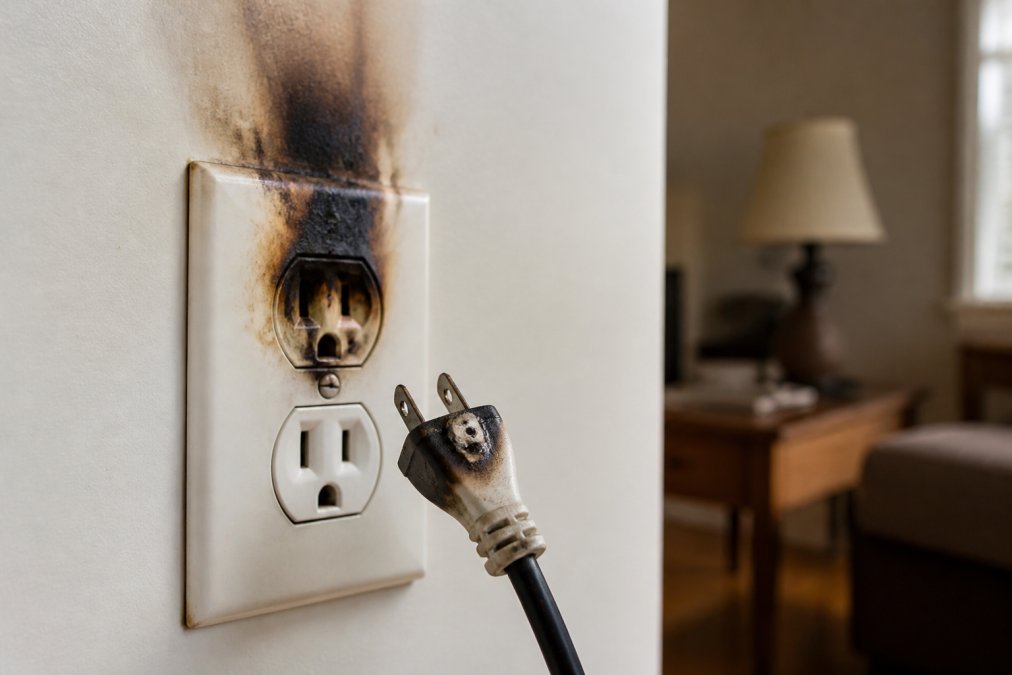
Putting a standard-duty receptacle on a full-load charging circuit is one of the most common shortcuts we correct, the result is a hot, discolored outlet that fails long before the charger does.
EV Charger Outdoor Installation: Weather, Code, and Placement
EV charger outdoor installation adds two variables indoor work does not: moisture and physical protection. A charger on an exterior garage wall or carport post must handle rain, snow, temperature swings, and the occasional bump.
Placement decisions that matter:
Height and reach. Mount the unit where the cable reaches the charge port without strain and the holster stays off the ground.
Weather exposure. Choose a unit rated for outdoor use and, for plug-in setups, a receptacle enclosure rated for wet locations.
Cable management. A coiled cable stiffens in freezing weather; plan a holster or hook.
Hardwired units generally handle exterior walls more cleanly because there is no plug connection to shelter. Plug-in units work outdoors too, but the receptacle enclosure and cover have to be right.
Matching the Charger to Your Electrical Panel and Driving Habits
The right charger is the one your panel can actually support. Before choosing hardwired vs plug-in, we check available capacity, the panel's age and condition, and whether the service can carry another continuous load. If you are unsure whether your panel is up to the job, learn how to tell if your electrical panel needs an upgrade.
How Panel Capacity Is Actually Determined
"Available capacity" comes from a load calculation, not a guess. An electrician tallies the existing load using the code's method, general lighting and receptacle load, nameplate ratings of fixed appliances, range and dryer demand factors, and existing large continuous loads, then compares that total against the service rating. The gap is what's available for EV charging.
A few practical realities follow from that:
The service size sets the ceiling. A 100-amp service has far less headroom than a 200-amp service, and a house with electric range, electric dryer, and central air may have little left over.
The panel, not just the service, matters. Even with service headroom, the panel needs physical space for a double-pole breaker and must be in sound condition. Age, corrosion, and known problem panel brands all factor in.
The charger's current setting is a choice. Many Level 2 chargers can be commissioned at a lower current than their maximum. Setting a 48-amp-capable unit to 32 or 40 amps can fit it inside available capacity without a service upgrade.
How Load Management Changes the Answer
If the panel is near its limit, load management can add charging without a full service upgrade. An energy-management device monitors the service or a specific circuit, throttles or pauses the charger when the house nears its limit, then restores full charging when demand drops.
There are two common forms:
Service-level management watches total draw at the main and reduces charging current dynamically so the service is never overloaded.
Circuit-sharing or power-sharing lets two loads, or two chargers, share a single circuit, splitting available current between them.
This is often the difference between a simple install and a major project. It also interacts with the hardwired vs plug-in choice: some energy-management setups are designed around a hardwired charger and its control wiring, while plug-in units vary in whether they support the same features.
Charging Speed Is Capped by More Than the Circuit
The circuit rating is only one of three limits on charging speed. The real rate is the lowest of:
The circuit's continuous capacity, a 50-amp circuit delivers 40 amps of continuous charging; a 60-amp circuit delivers 48 amps.
The charger's maximum output, a unit rated for 40 amps cannot exceed that even on a larger circuit.
The vehicle's onboard charger, many vehicles accept far less than the circuit can deliver, and some accept only 32 or 40 amps regardless of the wall unit.
That third limit is the one homeowners most often miss. Upgrading to a higher-amperage hardwired circuit does nothing for a vehicle whose onboard charger caps at 32 amps. Match the circuit to the car, not to the biggest number on the box.
Match the Setup to Your Situation
Your Situation | Better Fit | Why |
Own the home long term, park in a garage | Hardwired | Fewer failure points, higher amperage ceiling |
Rent, or plan to move within a few years | Plug-in | Take the charger with you |
Outdoor parking spot | Hardwired | Simpler weatherproofing, no exposed plug |
NEMA 14-50 outlet already installed | Plug-in | Fastest path to charging |
Panel near capacity | Either, with load management | Avoids unnecessary service upgrade |
Two EVs, one charger | Hardwired with power sharing | Cleaner permanent setup |
Vehicle onboard charger caps low | Either at matched amperage | Higher circuit adds no speed |
Daily driving distance matters as much as peak rate. A 30-mile commute is easily replaced overnight on a 32-amp circuit; a long daily drive or large battery benefits from the higher ceiling a hardwired circuit allows. Size for your actual miles, not the maximum the equipment can do.
Key Takeaway Panel capacity comes from a load calculation, not a guess. Load management can add charging without a service upgrade. And real charging speed is the lowest of the circuit's continuous capacity, the charger's output, and the vehicle's onboard charger, so match the circuit to the car.
Choosing Your EV Charger Setup with Star Bright Electric
The hardwired vs plug-in EV charger choice is really about your home, not which product is better on paper. Hardwiring wins on reliability, amperage, and outdoor durability; plugging in wins on portability and simplicity.
We have been wiring homes across the Cleveland and Akron areas since 1999, and EV charger work is a regular part of what we do. If your panel is older or already near its limit, we also handle service upgrades and panel replacements so the circuit can be done right the first time.
You can see the full range of what we handle on our residential services page, or get in touch to schedule an estimate and find out what your panel can support.
Frequently Asked Questions
What is the difference between a hardwired and plug-in EV charger?
A hardwired charger connects directly to a dedicated circuit with no outlet, so the wiring is permanent and enclosed. A plug-in charger uses a cord and plug into a matching receptacle, usually a NEMA 14-50 outlet on a 240-volt circuit. Hardwiring removes the plug connection and lets the unit run at higher amperage, while plugging in keeps the charger removable and easier to replace.
Can a plug-in Level 2 EV charger charge as fast as a hardwired one?
Often it can, but not always. A plug-in Level 2 EV charger on a 240-volt circuit delivers strong charging speed, and many drivers never notice a difference. The gap appears when a hardwired unit is set to a higher amperage than the plug and circuit allow. Your vehicle's onboard charger also caps the rate, so check that limit before assuming a bigger circuit buys faster charging.
Which type of charger is better for outdoor installation?
Hardwired units usually hold up better outdoors because there is no plug connection exposed to rain, snow, and temperature swings. For EV charger outdoor installation, a hardwired setup with proper weatherproofing and a GFCI breaker reduces failure points. A plug-in unit can work outside if the receptacle is rated for the location and protected from moisture, but inspect the plug and outlet regularly for wear.
Can a plug-in EV charger be converted to hardwired later?
Yes. A licensed electrician can remove the receptacle, hardwire the circuit, and adjust the breaker and settings to match the charger's rating. Converting is common when a homeowner wants a cleaner look, higher amperage, or fewer nuisance tripping issues. The work involves opening the circuit, so it should be planned with your panel capacity in mind rather than treated as a simple swap.
Adding a Level 2 charger should not feel like a gamble on your home's wiring. Star Bright Electric handles the panel check, the permit, and the install so the only thing you have to think about is where to mount the holster. Get started with Star Bright Electric and charge at home with a setup built for your panel, not a generic one-size answer.

Comments